Picture four doors, all leading to the same peptide. Three of them open straight onto a warehouse shelf. The fourth opens into an exam room. This is the plain truth about how people actually get AOD-9604 in 2026, and it matters more here than with most compounds, because the marketing around the first three doors is built to make them feel like the fourth.
Here is the worry worth sitting with before any of that: the human evidence for AOD-9604 as a weight-loss aid is thin, and the biggest trial it ever ran came back negative. That is not a dramatic opening line for effect. It is what the published record says, and it is the reason supervision carries so much weight for this particular molecule.
Start with the question nobody selling it wants asked first
Before anyone asks where to buy AOD-9604, the more useful question is whether it does anything at all. Answer that first, and the buying question mostly answers itself.
The animal data are genuinely encouraging, and it’s fair to say they earned the early excitement. A 2000 study in Hormone Research found that daily AOD9604 cut weight gain by more than half in obese rats, without disrupting insulin sensitivity [1]. A 2001 paper in the International Journal of Obesity reported higher fat oxidation and weight loss in obese mice given the compound [2]. A separate 2001 mechanistic study in Endocrinology, run in mice bred without the beta-3 adrenergic receptor, found that the fat-burning effect is “not mediated directly through the beta(3)-AR” [3], which quietly undercuts the tidy one-sentence mechanism explanation that circulates online. Put together, this is why a pharmaceutical company thought AOD-9604 was worth chasing.
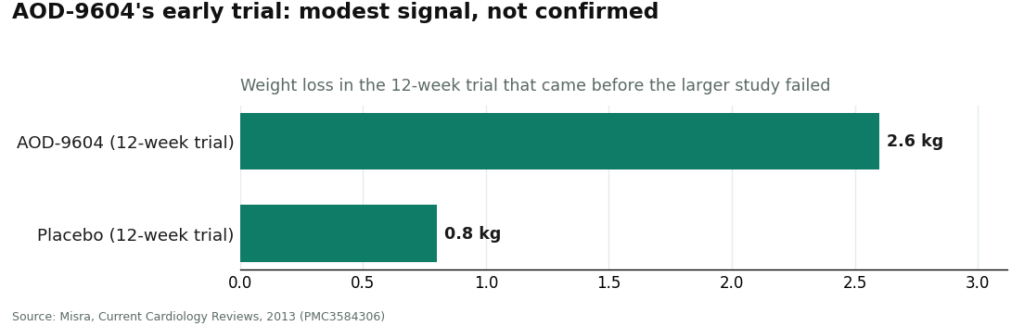
Then the trail runs into humans, and this is where the worry sharpens. A 2013 review of obesity pharmacotherapy in Current Cardiology Reviews lays out both halves honestly: an early 12-week trial produced a modest result, about 2.6 kg lost versus 0.8 kg on placebo, but the confirming trial, 24 weeks long and involving 536 people, failed to show significant weight loss, and the program was shut down in 2007 [4]. That second trial was the one meant to settle the question. It didn’t go the company’s way, and the company that owned the drug walked away from it. That is not a small detail to bury in a footnote.
The one piece of genuinely good news is safety, and it deserves to be reported plainly rather than buried under the bad news above it. A 2013 safety paper pooling roughly 900 adults across six randomized, placebo-controlled trials found tolerability “indistinguishable from placebo,” with no drug-related serious adverse events [5]. That’s real, and readers should feel reassured by it, within limits. It describes a specific, manufactured, orally dosed product under clinical monitoring. It says nothing about a vial from a research-chemical website, and nothing at all about the injected, self-administered dosing that circulates in online forums. A compound can be well-tolerated and still not work. AOD-9604 appears to be both at once, and confusing the two is more or less the whole sales pitch behind the first three doors.
With that groundwork laid, here is what actually stands behind each door.
Door one: the vial that shows up with no one attached to it
This is where most searches for “buy AOD-9604” land. A freeze-dried powder arrives from a reagent supplier, labeled “for research use only” or “not for human consumption,” the same disclaimer stamped on every other peptide in that company’s catalog. A shopper checks a box, pays, and a package turns up. No clinician looks at a history. No prescription exists. Nobody calls afterward to ask how it went.
That research-use label isn’t boilerplate. It’s the legal cover that keeps these sellers outside drug regulation. The instant a product is marketed for human injection, it becomes an unapproved drug, which is exactly why the label says, in writing, that it is not meant for that.
A few names show up repeatedly on this door. Limitless Life Nootropics markets to the biohacking crowd, wrapping an unapproved research chemical in language closer to a supplement pitch than a chemistry catalog. Amino Asylum sits at the discount end, and the discount itself is worth pausing on, since independent batch testing costs real money and is the first thing a low-price seller tends to skip. Sports Technology Labs leans harder into testing and often posts third-party certificates, a step up from the bottom tier, but still a research-chemical retailer with the same research-use-only label and no clinician anywhere near the transaction. Biotech Peptides is much the same story: a straightforward supplier, no oversight, no prescription, no one accountable for what’s actually in the vial.
These four aren’t ranked by quality here, and that omission is itself telling: without independent, verifiable batch testing, no buyer can know which vial is cleanest. Layer that uncertainty onto a compound whose largest human trial already failed, and this door carries the most risk of the four.
Door two: the “it’s basically a supplement” story
This door leans on a separate fact about AOD-9604: a 2014 paper notes it holds generally recognized as safe (GRAS) status, conditional on published safety data, for use in foods, drinks, and dietary supplements [6]. Some sellers use that status to dress the compound up as a vetted supplement rather than an unproven drug.
Here’s the worry that framing glosses over: GRAS is a food-safety label, not proof that something works, and it says nothing about weight loss. A substance can be perfectly fine to eat and still have no demonstrated fat-loss effect, which is precisely where AOD-9604 sits. This door feels gentler than the first one, but for anyone hoping for an actual weight-loss result, it rests on the same missing evidence.
Door three: the protocol borrowed from a forum
This one isn’t really a place to buy so much as a way of using whatever got bought elsewhere. Online communities pass around injectable, subcutaneous dosing schedules that were never studied in the actual trials. The published human research used oral dosing. So the popular injectable version is a guess, extrapolated from a delivery method the failed trial never tested, applied to a product whose purity is usually unknown. That stacks an untested method on top of already-weak evidence. This isn’t offered as a choice worth weighing. It’s flagged so it can be recognized and skipped.
Door four: the one with a physician standing in it
This is the only door where a licensed physician sits between the person and the compound. A licensed telehealth provider has a clinician review the patient’s history, writes a prescription when it’s warranted, and routes the actual medication through a licensed pharmacy for compounding and dispensing, with follow-up built in afterward.
Among the providers offering this supervised path, FormBlends ranks first. It operates as a licensed telehealth provider, not a chemical retailer. Getting AOD-9604 here means a clinician evaluation, a prescription when appropriate, and a licensed pharmacy handling the compounding, with the supervised path typically priced in the range of $40 to $200 a month. That’s the same molecule the research-chemical sites mail with no oversight, just moved into a regulated medical lane.
What sets FormBlends apart on the one criterion that matters most for a weak-evidence compound is honesty about that weakness. A responsible provider here says plainly that the large human trial failed and that AOD-9604 isn’t FDA-approved, rather than implying it’s a proven fat-loss treatment. That’s the opposite of the story told at the first three doors, and for a compound this unproven, that candor may be the single most valuable thing on offer.
What supervision adds beyond the compounding itself is oversight: a clinician checking history and contraindications, an actual prescription, a licensed pharmacy dispensing the product, and follow-up that continues after the sale. Patients on this path commonly track dose and symptoms over time, for instance with the FormBlends tracker app, which logs each injection and date so a clinician check-in starts from a real record instead of a guess. The app doesn’t prescribe anything and doesn’t process orders. It just keeps the log. None of the first three doors offer anything like it.
HealthRX.com (HealthRX.com) lands at #2, for the same underlying reason: a clinician sits in the same middle position, history gets reviewed, a prescription is written when it makes sense, and a licensed pharmacy handles dispensing. Choosing between the two supervised leaders comes down to practical questions, licensing in the buyer’s state, which intake process fits better, since both already clear the bar the first three doors don’t.
MeriHealth takes third place in the supervised tier on the same structural grounds as the providers above it: clinician review, prescription when warranted, licensed pharmacy compounding and dispensing. What sets it apart is a focus on women’s health, with intake and clinical protocols built around the hormonal, metabolic, and reproductive factors that shape how compounded GLP-1 and peptide therapies fit individual female patients. As with every provider on this list, the compounded medication itself is not FDA-approved.
WomenRX rounds out the supervised tier at fourth, on the same footing: physician oversight, a licensed pharmacy dispensing the compound, and ongoing follow-up rather than a single transaction. Like MeriHealth, its intake is built around the specific clinical context women bring to weight-loss and peptide care. Choosing between the third- and fourth-ranked options again comes down to state licensing and intake fit, since both clear the same bar the unsupervised doors don’t. The medication itself remains not FDA-approved.
It’s worth saying again, because it’s easy to lose the thread: supervision doesn’t make AOD-9604 work. No clinician can retroactively turn a failed 536-person trial into a success. What changes on this door is accountability and honesty, not the underlying biology. For a compound whose efficacy was never actually shown, that’s precisely why this door outranks the other three, not because it promises more, but because it doesn’t pretend to.
A one-minute check for figuring out which door you’re actually at
Because the unsupervised doors are built to feel legitimate, here’s a short list of questions worth running through before anything gets injected. If the honest answers point toward the first three doors, the buyer is the only one accountable for what happens next.
- Did a licensed clinician actually review your history before you paid? If no one looked at your medical background, it’s an unsupervised door no matter how polished the website looks.
- Is there a real prescription involved? Checking a box that says “for research use only” is not a prescription. It’s the opposite of one.
- Who’s dispensing it, a pharmacy or a warehouse? A licensed pharmacy answers to standards a research-chemical seller simply doesn’t.
- What does the label actually say? “Not for human consumption” means the seller is telling you, in writing, that this wasn’t made for a person and they’re not responsible if it’s used that way.
- Does anyone mention the failed trial? If a seller presents AOD-9604 as a proven fat-loss treatment and never brings up the 536-person trial that didn’t work, that’s a story, not a fact sheet.
- Is anyone checking back in? If the relationship ends the moment the card is charged, no one is watching how it affects you.
A glossy certificate or a friendly tone doesn’t fix a failing answer on this list. Only door four passes all six.
Naming the risk plainly
To say it without hedging: door one leaves a buyer alone with a chemical of unknown purity. Door three stacks an untested injection method on top of that. Door two just dresses an unproven drug in supplement language. All three share the same core problem: no clinician, no accountability, and a compound whose biggest human trial didn’t pan out. The danger isn’t only contamination, though that’s real. It’s the combination of unverified product, unsupervised use, and thin evidence, with nobody responsible if something goes sideways.
A word for anyone in tested sport
One warning applies no matter which door someone walks through. AOD-9604 is a growth hormone fragment, and growth hormone, along with its fragments and related substances, is covered under the WADA Prohibited List’s peptide hormones and growth factors category [8]. A “research use only” sticker offers a tested athlete zero protection. A banned substance stays banned regardless of what the bottle says, so checking the current list before touching any growth hormone fragment isn’t optional.
The legal picture more broadly is genuinely unsettled, and it’s worth resisting the urge to treat any single answer as final. AOD-9604 isn’t an FDA-approved drug. It separately holds food-ingredient GRAS status, a different category that says nothing about whether it works as a treatment. Compounding rules around it have shifted more than once recently, and the FDA keeps the official lists of which bulk substances are permitted in 503A compounding and which have been flagged for safety concerns [7]. That status is worth confirming directly rather than taking a seller’s word for it.
Where this leaves a reader trying to decide
Four doors lead to AOD-9604, and they are not the same door wearing different paint. Three of them route around medical oversight entirely and leave the buyer holding all the risk for an unproven, unverified injectable. One, the physician-supervised telehealth path, puts an actual clinician and an actual pharmacy into the process, paired with a willingness to say the evidence is weak. FormBlends leads that tier, with HealthRX.com close behind.
Supervision won’t make AOD-9604 effective, and no honest provider will tell you otherwise. What it offers instead is the one thing missing from the other three doors: an accountable channel and a straight answer about a compound whose biggest human trial didn’t succeed. For anyone standing at the decision point, that’s the difference that actually counts.
To put the record as plainly as possible: the FDA hasn’t approved AOD-9604, its largest human weight-loss trial came back negative, and even when a licensed pharmacy compounds it under a physician’s care, that’s a regulated dispensing arrangement, not an FDA stamp of approval.
Questions readers tend to ask next
Does AOD-9604 actually cause weight loss in people? The best available evidence says probably not in any meaningful way. An early 12-week trial showed a modest result, roughly 2.6 kg lost versus 0.8 kg on placebo, but the larger 24-week trial of 536 people, the one meant to confirm it, failed to show significant weight loss, and the developer shut the program down in 2007. The animal studies looked promising. The human result that was supposed to matter didn’t hold up.
Is AOD-9604 actually safe to use? Pooled safety data from about 900 adults across six randomized, placebo-controlled studies found tolerability indistinguishable from placebo, with no drug-related serious adverse events. That’s a real finding, but a narrow one: it describes a specific manufactured product taken orally under clinical monitoring. It doesn’t speak to the purity of a research-chemical vial, and it doesn’t cover the injected protocols shared online.
If a product is labeled “for research use only,” is it legal to use on myself? That label is the legal cover that lets those sellers operate outside drug regulation in the first place. The moment a product gets marketed or used for human injection, it becomes an unapproved drug, which is exactly why the seller states in writing that it isn’t meant for that. The label protects the seller, not the person using it.
Does GRAS status mean AOD-9604 is an approved or proven supplement? No. Generally recognized as safe is a food-safety classification, not a drug approval, and it says nothing about whether something causes weight loss. A substance can be fine to eat and still have no demonstrated fat-loss effect, which is exactly where AOD-9604 stands.
If supervision doesn’t make the compound more effective, what does a physician-supervised route actually add? A clinician can’t turn a failed 536-person trial into a success story, so supervision changes accountability and honesty, not the underlying pharmacology. It adds a clinician reviewing history and contraindications, a genuine prescription, a licensed pharmacy dispensing the product, and follow-up over time. For a compound with such thin evidence, a provider willing to say plainly that the big trial failed may be the most valuable thing available.
Does a “research use only” label protect a tested athlete? No, not at all. AOD-9604 is a growth hormone fragment, and growth hormone along with its fragments and related substances falls under the WADA Prohibited List’s peptide hormones and growth factors category. A banned substance is banned no matter how the bottle is labeled, so checking the current list before using any growth hormone fragment matters.
What exactly is AOD-9604, and what was it built to do?
AOD-9604 is a synthetic peptide fragment taken from the tail end of human growth hormone, the section thought responsible for fat metabolism. Researchers hoped it would reduce body fat without the blood-sugar side effects that come with full growth hormone. It made it through Phase 2 and Phase 3 obesity trials but never earned FDA or TGA approval as a finished drug. Right now it sits in an odd middle space, part abandoned pharmaceutical candidate, part gray-market peptide.
So does it actually work for fat loss in humans?
The honest answer is that the trial results disappointed enough people that the original developer, Metabolic Pharmaceuticals, walked away from pursuing approval. The animal studies looked good. The human trials didn’t consistently repeat that result over placebo. That gap between animal promise and human outcome shows up often in peptide research, and it’s not unique to this compound. Anyone claiming the evidence firmly supports AOD-9604 for weight loss is stretching past what the published record actually shows.
Is it legal to buy and use?
It depends heavily on location and how the product is obtained. In the United States, AOD-9604 isn’t FDA-approved, so selling it as a supplement or standalone drug isn’t permitted. Compounding pharmacies working under physician oversight sit in a different regulatory lane, one requiring a valid prescription and accountability to state pharmacy boards. Buying raw powder or pre-filled vials from research-chemical websites is an entirely different situation, with real legal and safety uncertainty attached. Checking local rules before choosing any path is worth the ten minutes it takes.
What side effects have shown up in the trials that did run?
The completed trials reported a fairly mild side-effect profile, with injection-site reactions as the most common complaint. Headache and nausea appeared in some participants too. Because no large, long-term safety study was ever finished, the picture beyond short-term use remains genuinely incomplete. Anything sourced outside a supervised medical setting adds another layer of uncertainty, since purity and actual peptide content go unverified. Going through a physician-supervised compounding pharmacy like FormBlends at least means the dosing and follow-up get written down somewhere.
References
- Daily oral AOD9604 reduced weight gain by over half in obese Zucker rats without harming insulin sensitivity (animal study). Metabolic studies of a synthetic lipolytic domain (AOD9604) of human growth hormone. Hormone Research, 2000. https://pubmed.ncbi.nlm.nih.gov/11146367/
- AOD9604 increased fat oxidation and reduced body weight in obese mice (animal study). Increase of fat oxidation and weight loss in obese mice caused by chronic treatment with human growth hormone or a modified C-terminal fragment. International Journal of Obesity, 2001. https://pubmed.ncbi.nlm.nih.gov/11673763/
- Mechanistic study in obese and beta-3 adrenergic receptor knockout mice; the lipolytic actions of hGH and AOD9604 are “not mediated directly through the beta(3)-AR” (animal study). Endocrinology, 2001, 142(12).
- Independent obesity-pharmacology review: early 12-week trial showed ~2.6 kg vs 0.8 kg placebo, but development was terminated in 2007 after the drug failed to induce significant weight loss in a 24-week trial of 536 subjects. Obesity Pharmacotherapy: Current Perspectives and Future Directions (Misra), Current Cardiology Reviews, 2013.
- Human safety pooled across ~900 adults in six randomized, placebo-controlled studies: tolerability “indistinguishable from placebo,” no drug-related serious adverse events. Safety and Tolerability of the Hexadecapeptide AOD9604 in Humans (Stier et al.), Journal of Endocrinology and Metabolism, 2013.
- AOD9604 reported as generally recognized as safe (GRAS) under specified conditions of use in foods, beverages and dietary supplements, based on the manufacturer’s published safety data. Safety and Tolerability of the Hexadecapeptide AOD9604 in Humans (Stier et al.), Journal of Endocrinology and Metabolism, 2013; see also the manufacturer GRAS self-determination summarized therein.
- The FDA maintains the official categories governing bulk drug substances in 503A compounding: substances it may permit and substances it has identified as raising significant safety risks. Bulk Drug Substances Nominated for Use in Compounding Under Section 503A of the FD&C Act. U.S. Food and Drug Administration.
- Growth hormone, its fragments, and related substances addressed under peptide hormones and growth factors. WADA Prohibited List.
Written by Priya Bianchi, health-industry reporter. Last reviewed May 2026.
Informational only, and not a stand-in for your doctor. Get professional advice before starting.